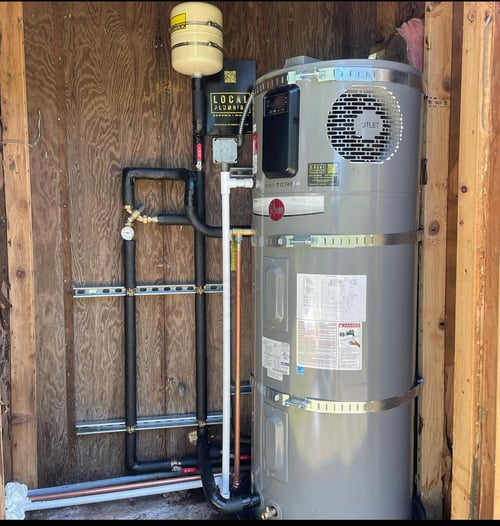
If you are switching from a gas water heater to a heat pump water heater (HPWH), you might notice the new unit is larger or that your installer recommends a tank with a higher gallon capacity (e.g., replacing a 50-gallon gas water heater with a 65-gallon HPWH).
Sizing up is a best practice that improves comfort, efficiency, and savings. Even if the gallon capacity is the same, HPWHs are physically bigger because the heat pump compressor and fan assembly sit on top of the tank.
Here are four reasons why HPWHs are typically larger than gas units.
To provide enough hot water.
A water heater's "first-hour rating" is the amount of hot water it provides in one hour of continuous use, starting with a fully preheated tank. It accounts for the size of the tank (bigger means more preheated water) and the rate at which it heats incoming water (called the recovery rate).
First-hour rating is the best metric to check if a water heater can provide enough hot water for your house.
Gas reheats water very quickly because of its high-temperature combustion. A high recovery rate gives it a good first-hour rating, even with a small tank. And it's the reason gas tankless water heaters are common.
While HPWHs are incredibly efficient, they have slower recovery rates. To ensure you don’t run out of hot water during back-to-back showers, a larger tank provides a bigger buffer of preheated water to compensate for the slower recovery rate.
A common rule of thumb is to go one size up for HPWHs: from a 50-gallon gas water heater to a 65-gallon HPWH - or from a 65-gallon gas to an 80-gallon HPWH.
Heating water is like a pancake breakfast. You have a full table, and everyone's hungry for pancakes! They're going to get full eventually, but you need to deliver pancakes quickly, or they'll start complaining.
Tank size: Good news, you have a head start! Your serving plate is full of pre-made pancakes that are ready to go. This is equivalent to the size of your water heater. Bigger tank = more pre-made pancakes.
Recovery rate: How quickly can you make more pancakes?
First-hour rating: If plates are empty, people will start complaining. How many pancakes can you deliver in one hour? It depends on your number of pre-made pancakes (tank size) and how quickly you can make new ones (recovery rate).
To keep everyone happy (i.e. not run out of hot water), your tank size and recovery rate need to align to deliver a first-hour rating that matches your hot water consumption.

To avoid inefficient backup heating.
Most HPWHs are "hybrid" units, meaning they have backup electric resistance heating elements (like a standard electric water heater) to help when demand is high. However, these elements use significantly more energy than the heat pump.
A small tank depletes quickly, forcing the unit to use expensive backup heating to keep up. Whereas a larger tank holds more preheated water, so it can rely more on the efficient heat pump to slowly and steadily heat the water, keeping you in "heat pump mode" and maximizing your savings.
To take advantage of low-cost (and low-carbon!) electricity.
A larger tank acts like a thermal battery. It allows you to heat a large volume of water when electricity is cheapest (off-peak hours) and store it for use throughout the day.
By "load shifting," the HPWH can coast through times when electricity prices are high without needing to turn on, lowering your utility bill. This can also reduce your peak demand and ease constraints on your electrical panel.
And the carbon intensity of electricity generation changes throughout the day. Off-peak electricity is generated with lower carbon resources, so shifting your consumption away from on-peak hours lowers your emissions even more. This also applies to using your own solar panels to heat water during the middle of the day.
.jpg?width=500&height=500&name=Cora%20balcony%202%20(square).jpg)
Larger 65- or 80-gallon 120V heat pump water heater make it easier to shift peak electrical load. This helps houses with limited panel capacity (typically 100A or less) avoid expensive panel upgrades.
And sometimes, to reduce installation costs (after incentives).
While a larger tank often has a higher sticker price, it may end up being cheaper or comparable after rebates. Many utility and government incentives are specifically targeted at high-efficiency HPWHs. Because the larger tanks offer greater potential for grid load shifting and energy savings, they are often the target of these financial incentives.